
Your High Value Players should never have to ask to be treated like they matter. At Toeshee, every High Value Player receives the white-glove treatment they deserve, whether the client asks for it or not.
A culture of service is one of our core values. It shapes our work ethic, our standards and how we care for the player relationships you entrust to us.
AI is already in player support
More than half of the operators in a 2026 SBC Media and Comm100 survey had already deployed or were piloting AI agents in player support. Outside gaming, Coinbase told investors in October 2025 that 65% of its customer-support interactions were fully automated.
For a Head of Player Support, the question is who can be trusted with the conversations that carry the most weight. High Value Player relationships and responsible-gambling escalations require expertise, judgment and personal responsibility for the quality of care. That combination is central to Toeshee's approach.
1. High Value Player conversations
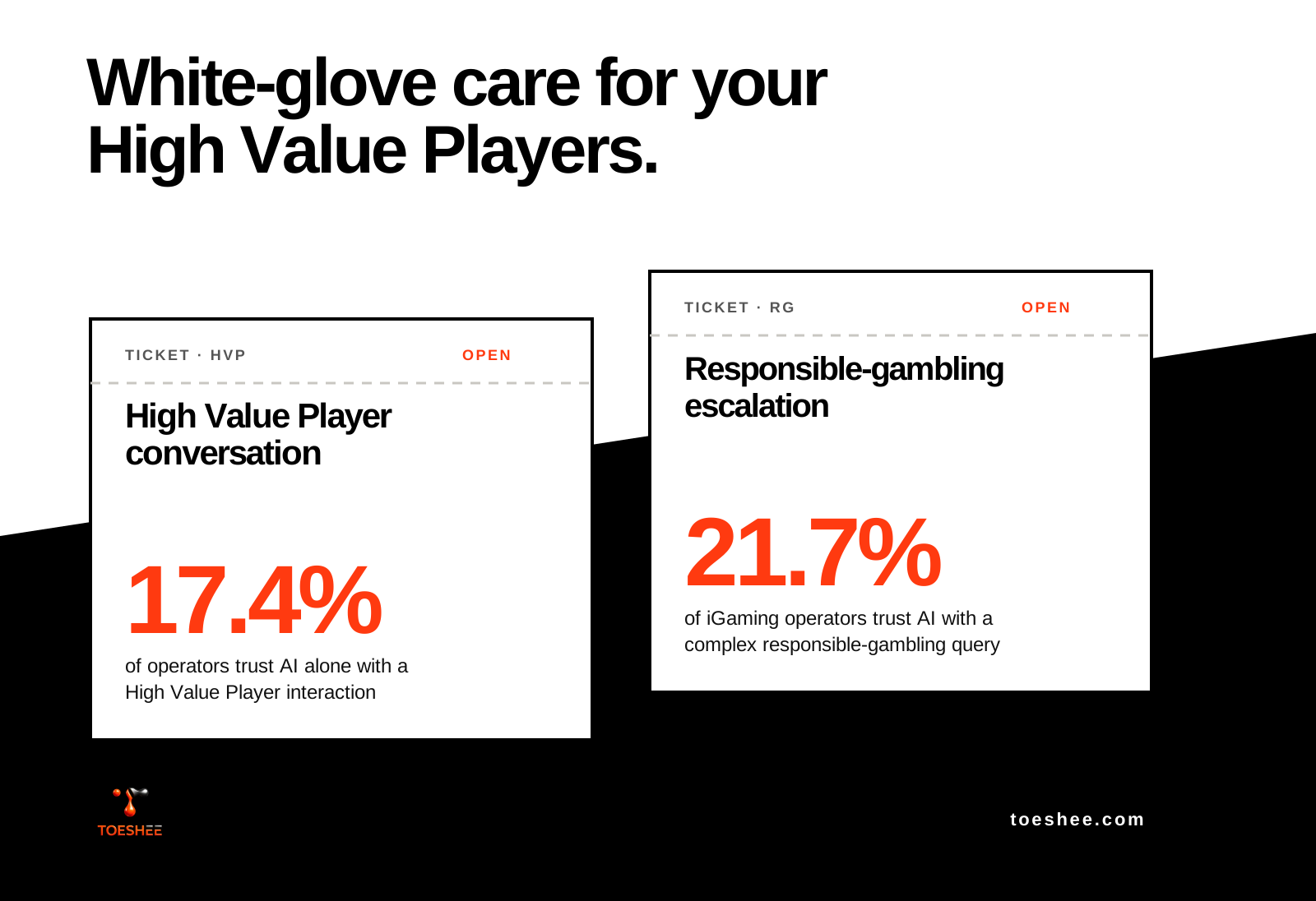
High Value Players matter because a relatively small group can account for a meaningful share of an operator's revenue. Losing even a few of those relationships can have consequences far beyond the number of tickets involved. Only 17.4% of operators in the SBC Media × Comm100 benchmark would let AI handle a High Value Player interaction on its own.
That makes mishandling even a small share of these conversations a business risk. A poorly explained withdrawal delay, an unresolved account issue or a player repeatedly having to retell their story can weaken trust. Where revenue is concentrated, a few dissatisfied players can represent a disproportionate loss of future value and undermine the investment made in acquiring and serving them.
The warning signs may be hard to see. The Playa, Gaming Operations Academy and WarriorLab surveyed 70 professionals who serve High Value Players in 2026. iGaming Business reported that:
- 46% often or very often see High Value Players become inactive without warning.
- 71% have player data spread across several systems.
- 38% worry that AI could reduce the personal, human touch.
This is why the culture of the team serving your High Value Players matters. A service agreement can define response times. The people handling the conversation still have to care enough to understand the frustration, take ownership and see the issue through. A closed ticket means little if the player leaves feeling unimportant.
At Toeshee, High Value Player relationship management is a core competency, and a culture of service is one of our core values. We give every High Value Player the white-glove treatment they deserve, whether our client asks for it or not. That care is part of our culture and work ethic.
For us, white-glove service means:
- Making the player feel heard. The conversation starts with the person and the context, not a canned answer.
- Explaining the next step clearly. The player should know what is happening, who owns it and when they will hear back.
- Taking responsibility for follow-through. A handoff does not end ownership of the relationship.
- Knowing when specialist judgment is required. Commercial value never overrides player protection or regulatory obligations.
When you put your High Value Players in Toeshee's hands, you are choosing experts whose service culture makes this level of attention an everyday expectation.
2. Responsible-gambling escalations
Operators report much higher trust in AI for moderate reactive help (60.9%) and proactive engagement (65.2%). For a complex responsible-gambling query, trust drops to 21.7%.
The same benchmark helps explain why. Every operator surveyed trains support agents on responsible-gambling behaviours. Even so:
- 55.2% cite limited integration with responsible-gambling systems as their biggest compliance challenge.
- 51.8% still rely on manual supervisor review.
- 30% give players no direct route to a responsible-gambling specialist.
Regulators look closely at these conversations. In October 2025, Ontario's AGCO issued a C$105,000 monetary penalty against theScore, alleging that clear warning signs—including distress disclosed to a High Value Player host—did not lead to meaningful intervention.
In Great Britain, the Gambling Commission fined Spreadex £2.022 million after anti-money-laundering and social-responsibility failures. One cited case involved a customer who hit a daily deposit limit 12 times in 14 days; the operator used four pop-up messages and did not carry out a human interaction.
Neither action proves that AI mishandled a ticket. Both show why an alert is not an intervention. Responsible-gambling concerns require timely attention, specialist judgment and a record of what happened next. High Value Player expertise includes knowing when player protection must take priority over the commercial relationship.
What these numbers do not show
- The SBC/Comm100 figures measure what operators say they trust AI to handle. They are not observed failure rates.
- The Playa study has 70 respondents and was produced by vendors serving the sector.
- Coinbase's 65% is the company's own aggregate figure from its Q3 2025 earnings call. It does not reveal which ticket types were automated, and it is a comparison from outside iGaming.
Treat the numbers as operating signals, not universal performance benchmarks. They identify where operators want specialist oversight; they do not prove that every automated interaction in these categories goes wrong.
Look beyond the closed ticket
Review a sample of last month's High Value Player conversations: delayed withdrawals, repeat contacts, account restrictions and complaints that required several handoffs.
- Did the player receive a clear explanation?
- Did someone take ownership?
- Was the next contact kept?
- Was the issue resolved in a way that preserved trust?
Review responsible-gambling escalations for timely specialist involvement and documented follow-through, too. Closure rate tells you whether a queue moved. These questions tell you whether the relationship was cared for.
Common questions
Does this mean AI player support does not work?
No. Operators report much higher trust for moderate reactive help and proactive engagement, and Coinbase says most of its support interactions are fully automated. The data shows where operators draw the line: High Value Player conversations and complex responsible-gambling cases.
Do these figures prove AI fails on these conversations?
No. The surveys measure reported trust and concerns, not AI failure rates. They help identify where operators want specialist oversight; they do not establish that every automated interaction in these categories goes wrong.
Why trust Toeshee with High Value Player relationships?
Because our expertise is backed by a culture of service, one of Toeshee's core values. Every High Value Player receives white-glove treatment, whether the client requests it or not. Personal attention and follow-through are part of our everyday standard.
Why do operators trust AI less with responsible gambling?
These cases combine regulatory exposure, incomplete context and human judgment. Recent enforcement actions show that identifying a warning sign is not enough: an operator must make a timely, proportionate intervention.
What should a Head of Player Support track?
Track overall automation alongside how High Value Player and responsible-gambling conversations are handled. Review repeat contacts, handoffs, unresolved issues, specialist response time and relationship outcomes—not closure rates alone.
Give your High Value Players the Toeshee standard of care
If mishandling even a few High Value Player relationships could materially hurt your business, the culture of the team serving them deserves your attention. Choose a partner whose people see exceptional service as their responsibility every day.
Bring Toeshee a difficult player scenario or a recurring service problem. We'll show you how our experts would handle it and how our culture of service supports the white-glove care your High Value Players deserve.
White-glove care is a culture, not a queue.